
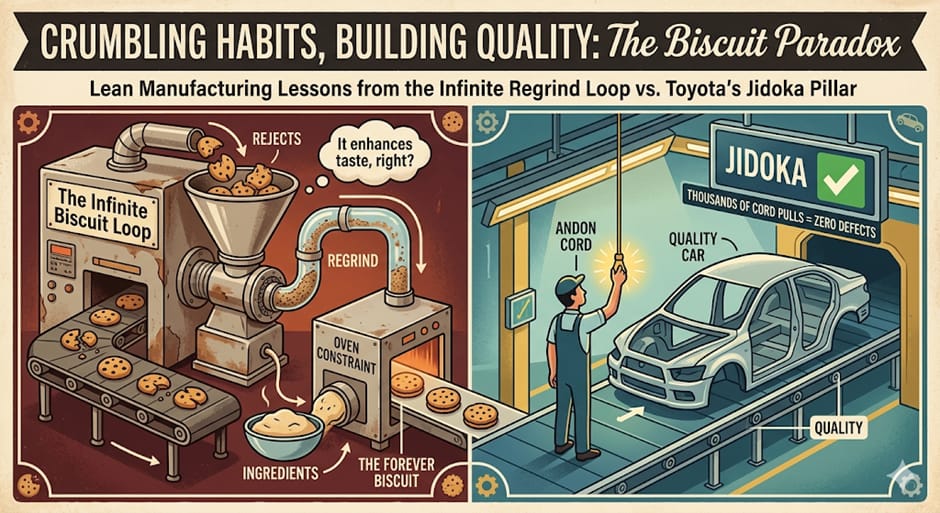
1. The Cookie Crumbles: An Infinite Loop
Have you ever heard the urban myth about the ceramic producer who intentionally ramped up their production of “seconds” simply because their factory shop was running out of stock? It sounds absurd, but truth can be stranger than fiction! Let’s talk about the “infinite or forever biscuit”—a wild manufacturing cycle where factories produce, bake, reject, regrind, and repeat. Over the years, I have been incredibly fortunate to work in multiple snack and biscuit facilities. In some of these plants, the standard treatment for post-baking rejects and breakages has been to regrind them and feed them right back into subsequent batches, wherever it is legal to do so.
It gets wilder. In one facility, an improvement team actually won an award for successfully bumping up the amount of regrind included in their subsequent batches! The site’s next grand plan was to look into automating parts of that very process loop. Over time, a myth gradually developed that this regrind somehow enhanced the manufacturability, taste, and consistency of the finished product. Eventually, regrind became completely acceptable and the norm, formally written into recipe cards and bills of materials.
Standout Summary: The Infinite Regrind Loop
- Some biscuit factories continuously regrind broken or rejected baked goods and add them to new batches.
- In extreme cases, adding more regrind was praised, rewarded, and even formally written into official recipes.
- This creates a loop where a proportion of product ingredient might be destined never to leave the factory, staying forever in the infinite regrind loop.
2. The Toyota Paradox: Pulling the Cord on Bad Habits
This biscuit-grinding obsession stands in stark contrast to the Toyota Production System (TPS), which features three major counter-intuitive realities. These are powerful contradictions or paradoxes that require astonishing levels of initial leadership commitment to embed. The three pillars point to different paradoxes: the Just-In-Time (JIT) pillar points to the efficiency paradox, the Jidoka pillar points to the quality paradox, and kaizen points to the engagement paradox.
Let’s look at the quality paradox, which can be very roughly approximated as prioritizing “quality over quantity”. The practical embodiment of this is the Andon system. Context is important, but in a car plant, the number of Andon cord pulls can be in the thousands each day. (It’s worth noting these don’t all result in line stops; if the issue is solved before the end of the takt time, the line continues ). With so many cord pulls, you’d naturally think both quality and productivity would go down, wouldn’t it? Yet, it hasn’t, and this is the busted paradox in action—achieving both quality and quantity simultaneously.
Standout Summary: The Power of Jidoka
- The Toyota Production System (TPS) relies on three counter-intuitive realities, or paradoxes.
- The Jidoka pillar champions the quality paradox, which means focusing on “quality over quantity”.
- Using the Andon system to flag issues stops defects and miraculously achieves both high quality and high productivity at the same time.
3. Baking Better: Breaking the Regrind Cycle
So, how does our friendly factory regrind loop stack up against Toyota’s gold standard? Well, making regrind the norm is the absolute antithesis of zero defects and the Jidoka pillar. It perfectly illustrates just how unbelievably hard it is to overcome the quality paradox. The absolute commitment to quality is fundamental to lean, yet it is so often just a secondary consideration.
Think about the oven: it is often the line constraint, and even if it isn’t, it is almost certainly going to be the largest energy consumer on the floor. It should be utilized to its maximum wherever possible. If we are sending regrind around within each batch, we are obviously reducing throughput and increasing costs. While I understand it is totally impractical to stop a continuous flow process the way an Andon system does, it is entirely reasonable to target the eventual elimination of regrind. Without doing so, you risk creating that infinite loop where ingredients never leave the factory. If you are looking to automate your regrind or put an efficiency metric on your rework area, please think about the TPS quality paradox instead.
Ready to escape the infinite loop?
If your processes feel a little too “reground” and you’re looking to embrace true, quality-first manufacturing, let’s chat!