
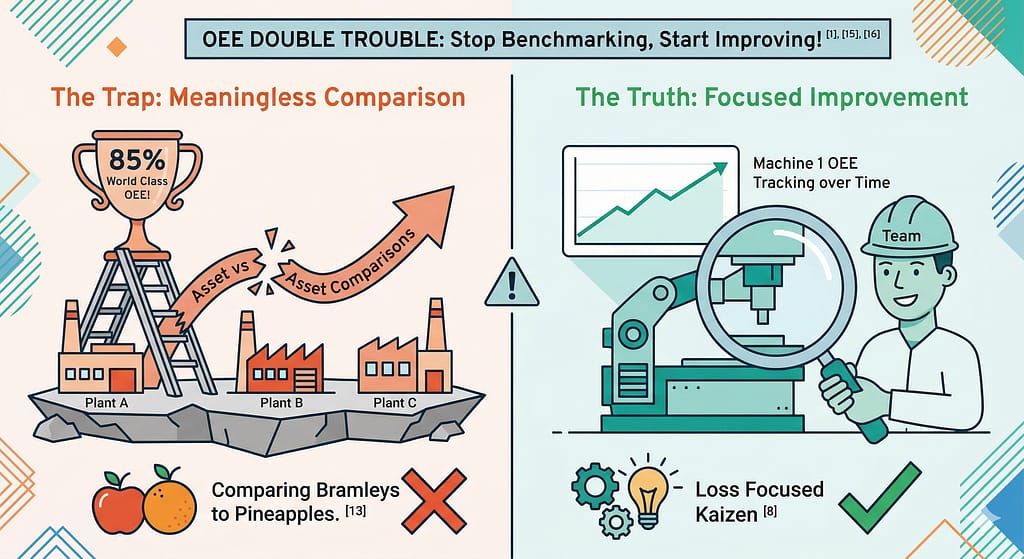
I can understand the (sometime) human craving for neat, tidy numbers to make sense of the world. It is tempting, and I can see why, as a manager or leader, you might succumb to the allure of a single, easy-to-digest metric. You want a single pseudo-scientific number with which you can quickly judge asset vs asset, line vs line, and plant vs plant. Combine that with the “85% World Class” accelerator, and you are almost guaranteeing increased “output” everywhere, all at once!
But here is a gentle reality check: output isn’t “Throughput,” so even though your activity would increase, higher sales probably won’t.
The Real Danger: Losing the Plot on TPM
The most significant Total Productive Maintenance (TPM) risk is that through the incorrect and inappropriate use of Overall Equipment Effectiveness (OEE), one can move away from the core purpose of TPM altogether.
OEE isn’t meant to be a vanity metric for the boardroom. OEE is intended to aid loss focussed kaizen, natural work team engagement, respect for the equipment, and asset based improvement. If TPM becomes secondary to “output,” then the intent and application are irrevocably diminished. Please don’t allow OEE to overshadow TPM and kaizen.
What the Experts Say
Lean and TPM experts all agree that benchmarking OEE is a fundamental misstep.
The Lean Toolbox Wisdom In the Lean Toolbox, John Bicheno writes, “Do not measure OEE plant-wide. Combining machine performance is meaningless. Target only critical machines. Pareto!”.
The Singular Machine Rule Michel Baudin comments, “OEE is supposed to be used only to track one machine over time. It is supposed to be used neither to compare different machines on a floor nor to benchmark companies”.
Apples to Apples (Or Bramleys to Bramleys) In their Shingo Award winning book on TPM, Andy Brunskill, John Quirke, and the late TPM legend Peter Willmott say that OEE isn’t a benchmark or comparator. They warn that if ‘corporate’ insists, then beware of not comparing like with like – not just ‘apples with apples’ but ‘Bramleys with Bramleys’. (They then cover 5 super questions to follow with!) .
The Danger of Comparison World-renowned OEE expert Arno Koch says comparing OEE scores between different assets, lines, or factories is one of the most common mistakes. He points out that unless the context, products, and calculation methods are identical—which they rarely are—such comparisons are meaningless at best and dangerously misleading at worst. OEE’s power lies in tracking trends and driving improvement on a specific asset.
📌 Summary Standout: The Golden Rules of OEE
- OEE is not a benchmark: You should never use it as a single number to quickly judge asset vs asset, line vs line, or plant vs plant.
- Output ≠ Throughput: Pushing for “85% World Class” might boost activity, but output isn’t throughput, so higher sales probably won’t follow.
- Keep the core focus: The biggest danger of misusing OEE is moving away from the core purpose of Total Productive Maintenance (TPM) altogether.
- Use it for specific improvement: OEE’s real power is tracking trends on a specific asset to aid loss-focused kaizen and team engagement.
- Don’t combine scores: Measuring OEE plant-wide or combining machine performance is completely meaningless.
Let’s Chat!
Are you worried your facility might be falling into the OEE comparison trap? It takes real human leadership to shift the culture back to true continuous improvement and asset respect. Let’s untangle your data and get your TPM strategy back on track.
Contact me to keep the conversation going!