
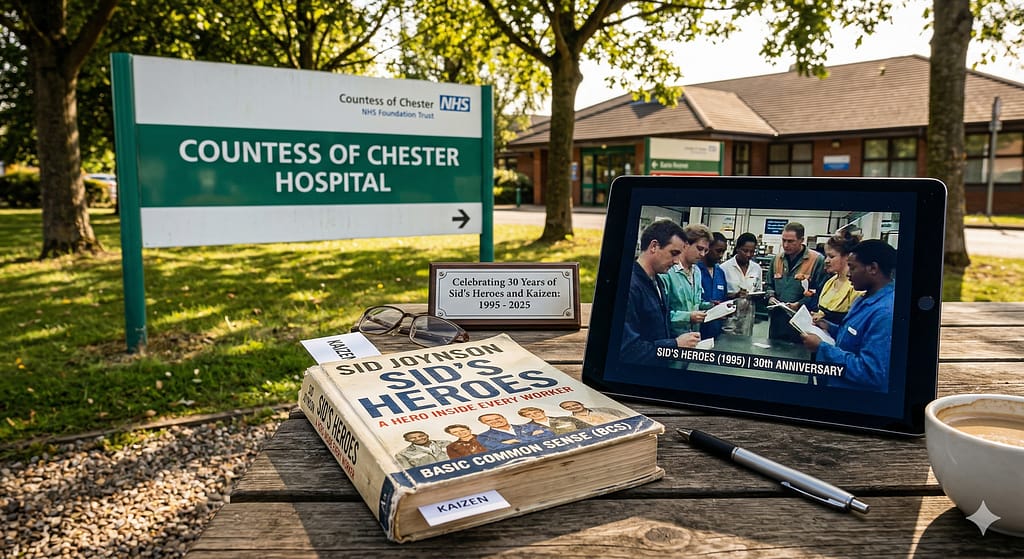
Let’s take a quick trip down memory lane, shall we? Back in the early 1990s—well before “Lean Thinking” became the ultimate corporate buzzword—the UK’s industrial sector was hit by a rather energetic phenomenon known as the “kaizen blitz”.
It was a transformative era. In 1992 and 1993, Paddy Hopkirk’s factories played host to the Kaizen Institute®. Hot on the heels of that, Sid Joynson rolled up his sleeves in 1994 to film the infamous “Sid’s Heroes” programmes. When the series finally aired in 1995, it gave us an unfiltered look into six different sectors and workplace settings.
Spoiler alert: it wasn’t always smooth sailing. The show brilliantly exposed the very real tensions that existed between workers and management. Because one of the featured settings happened to be The Countess of Chester—my local hospital trust—I thought it would be incredibly apt to author a couple of blog posts to mark this 30-year anniversary.
Over the next few posts, we’ll be investigating whether the kaizen and management landscape has actually changed much in the three decades since this iconic series graced our TV screens.
To get our mental gears turning, let’s look at two of the main discussion points;
🧠 Discussion Point 1: Death to Acronyms, Long Live BCS!
Let’s talk about BCS (Basic Common Sense). In the series, Sid showed very little enthusiasm for the corporate world’s beloved three-letter acronyms like JIT (Just In Time), TQM (Total Quality Management), or BPR (Business Process Re-engineering). Instead, he preferred to rely on plain old BCS. The Big Question: Does that straightforward approach still work today?
🦸 Discussion Point 2: The Hero Within
Sid famously declared that there is “A hero inside every worker”. Throughout the programme, he passionately emphasised his belief that inside every worker—every person, really—there lies a hero. He claimed, “If you handle things correctly, you can transform them into people who can make a great difference”. The Big Question: Is that optimistic view still true of today’s workers?
Let’s Chat! ☕
Has the workplace really evolved since 1995, or are we just dressing up the same old tensions in modern clothing? I’d love to hear your thoughts before I dive into the next post!
Contact me today by leaving a comment below, shooting me a message on LinkedIn. Let’s keep the conversation going!