
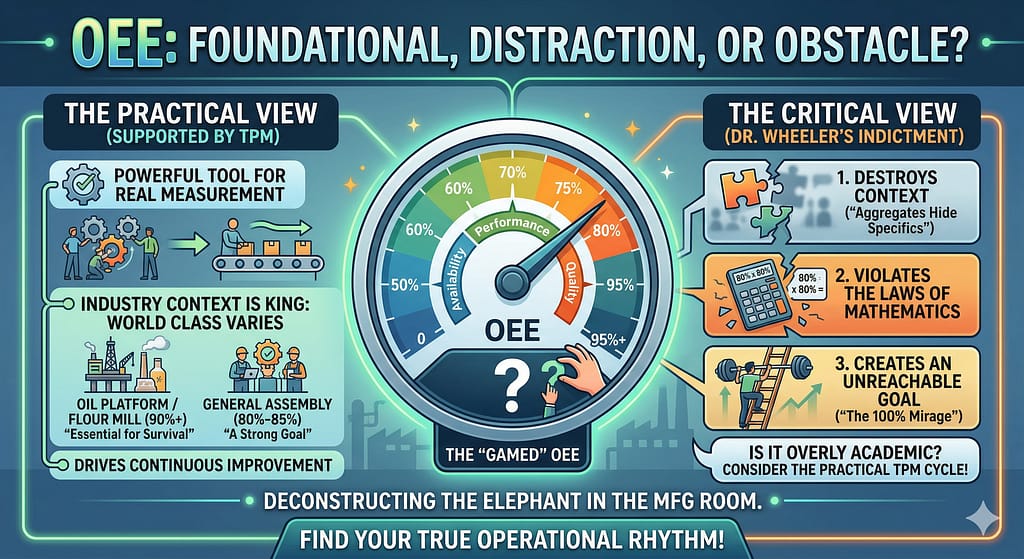
Catalysed by Dr Wheeler’s recent Quality Digest article deconstructing OEE (link below) in my next few posts I am going to summarise a series of issues, problems, thoughts and opinions from various sources and authors. It doesn’t pay to over-simplify, sensationalise or distort without knowledge and context as there are many and varied viewpoints. This isn’t intended as a defence. OEE was always enthusiastically discussed amongst the MSc Lean Enterprise deliverers and students as it always has been at many of the facilities I have visited and supported.
The validity of “world class” OEE of 85% is an example of one such blue touch paper. The recent Shingo Publication Award winning book “𝗧𝗣𝗠: 𝗔 𝗙𝗼𝘂𝗻𝗱𝗮𝘁𝗶𝗼𝗻 𝗼𝗳 𝗢𝗽𝗲𝗿𝗮𝘁𝗶𝗼𝗻𝗮𝗹 𝗘𝘅𝗰𝗲𝗹𝗹𝗲𝗻𝗰𝗲” by SA Partners Andy Brunskill, John Quirke and the late TPM legend Peter Willmott tackles this very question in a section dedicated to “𝗱𝗶𝘀𝗽𝗲𝗹𝗹𝗶𝗻𝗴 𝘀𝗶𝘅 𝗰𝗼𝗺𝗺𝗼𝗻 𝗺𝘆𝘁𝗵𝘀 𝗮𝗯𝗼𝘂𝘁 𝗢𝗘𝗘”. They comment that “𝘪𝘵 𝘤𝘦𝘳𝘵𝘢𝘪𝘯𝘭𝘺 𝘪𝘴 𝘯𝘰𝘵 𝘪𝘧 𝘺𝘰𝘶 𝘢𝘳𝘦 𝘳𝘶𝘯𝘯𝘪𝘯𝘨, 𝘴𝘢𝘺, 𝘢 𝘧𝘭𝘰𝘶𝘳 𝘮𝘪𝘭𝘭 𝘰𝘳 𝘢𝘯 𝘰𝘧𝘧-𝘴𝘩𝘰𝘳𝘦 𝘰𝘪𝘭 𝘱𝘭𝘢𝘵𝘧𝘰𝘳𝘮. 𝘐𝘯 𝘵𝘩𝘪𝘴 𝘤𝘢𝘴𝘦 𝘪𝘧 𝘺𝘰𝘶’𝘳𝘦 𝘯𝘰𝘵 𝘩𝘪𝘵𝘵𝘪𝘯𝘨 90%+ 𝘵𝘩𝘦𝘯 𝘺𝘰𝘶’𝘭𝘭 𝘴𝘰𝘰𝘯 𝘣𝘦 𝘰𝘶𝘵 𝘰𝘧 𝘣𝘶𝘴𝘪𝘯𝘦𝘴𝘴”. They add that “𝘪𝘵 𝘪𝘴 𝘯𝘦𝘤𝘦𝘴𝘴𝘢𝘳𝘺 𝘵𝘰 𝘭𝘰𝘰𝘬 𝘪𝘯𝘴𝘪𝘥𝘦 𝘵𝘩𝘦 𝘖𝘌𝘌 𝘢𝘯𝘥 𝘵𝘰 𝘵𝘩𝘦 𝘪𝘯𝘥𝘶𝘴𝘵𝘳𝘺 𝘤𝘰𝘯𝘵𝘦𝘹𝘵 𝘵𝘰 𝘥𝘦𝘵𝘦𝘳𝘮𝘪𝘯𝘦 𝘸𝘰𝘳𝘭𝘥 𝘤𝘭𝘢𝘴𝘴”.
Over the years OEE has been dismissed, mis-understood, mis-used, mis-calculated, mis-quoted and most certainly “gamed”. What is true and accurate, if there is even an answer?
I am a Dr Wheeler fan as he authored one of my favourite business books “𝗨𝗻𝗱𝗲𝗿𝘀𝘁𝗮𝗻𝗱𝗶𝗻𝗴 𝗩𝗮𝗿𝗶𝗮𝘁𝗶𝗼𝗻: 𝗧𝗵𝗲 𝗞𝗲𝘆 𝘁𝗼 𝗠𝗮𝗻𝗮𝗴𝗶𝗻𝗴 𝗖𝗵𝗮𝗼𝘀”. He has an MS and PhD in statistics. He was a student and colleague of Prof W. Edwards Deming for 21 years and is a recipient of the Deming Medal. He is a fellow of both the American Statistical Association (ASA) and American Society for Quality (ASQ). As you can guess he has a particular viewpoint about OEE. In the article he sets out his particular indictment against OEE. He states “𝘵𝘩𝘦 𝘖𝘌𝘌 𝘢𝘨𝘨𝘳𝘦𝘨𝘢𝘵𝘦 𝘷𝘢𝘭𝘶𝘦 𝘩𝘢𝘴 𝘵𝘩𝘳𝘦𝘦 𝘮𝘢𝘫𝘰𝘳 𝘧𝘭𝘢𝘸𝘴: 𝘐𝘵 𝘥𝘦𝘴𝘵𝘳𝘰𝘺𝘴 𝘤𝘰𝘯𝘵𝘦𝘹𝘵, 𝘪𝘵 𝘷𝘪𝘰𝘭𝘢𝘵𝘦𝘴 𝘵𝘩𝘦 𝘭𝘢𝘸𝘴 𝘰𝘧 𝘮𝘢𝘵𝘩𝘦𝘮𝘢𝘵𝘪𝘤𝘴, 𝘢𝘯𝘥 𝘪𝘵 𝘤𝘳𝘦𝘢𝘵𝘦𝘴 𝘢𝘯 𝘶𝘯𝘳𝘦𝘢𝘤𝘩𝘢𝘣𝘭𝘦 𝘨𝘰𝘢𝘭”. He then goes on to expand on each of these points.
However, this viewpoint could be said to overlook how powerful OEE is in the real, practical measurement cycle phase of a Total Productive Maintenance (TPM) programme and thereby be overly academic.
📦 Standout Summary: The OEE Reality Check
The 85% Myth: The validity of a “world class” OEE of 85% is an example of a debated topic that lights the blue touch paper.
Context is King: The Shingo Publication Award-winning book “TPM: A Foundation of Operational Excellence” (by SA Partners Andy Brunskill, John Quirke, and the late Peter Willmott) tackles this by dispelling six common myths about OEE.
Industry Matters: The authors point out that if you are running a flour mill or an off-shore oil platform, hitting anything less than 90%+ means you’ll soon be out of business. You absolutely must look inside the OEE and the industry context to determine what “world class” actually is.
John Bicheno reminds us that: In The Lean Toolbox (and during the MSc Lean) we gave quite a long list of cautions about OEE. These include 85% is not universal and could be dangerous; the three factors do not have equal importance; open to much manipulation and gaming; you can improve OEE in good and bad ways; cost is ignored; availability is better tracked via MTTR and MTBF; OEE by shift, by machine, by group, by plant?; you should always graph the factors; etc.
In these series of posts I want to make the case that often OEE crowds out TPM and for different equipment and industries you need a different approach e.g. Hospitals, energy….For off shore and remote equipment, for example, alarms, controls and instrumentation are critical. Then building a bridge to digitisation, patterns and AI etc..
https://www.qualitydigest.com/inside/improvement-tools-article/oee-and-unreachable-goal-030525.html
📞 Let’s Keep the Conversation Going!
Are you struggling to find your facility’s true “world class” rhythm, or do you just want to debate the maths behind OEE? Contact me today! Let’s grab a virtual coffee and figure out if OEE is a foundation or an obstacle for your specific operations.